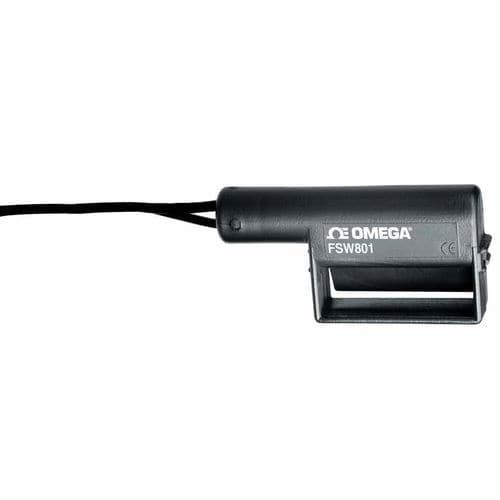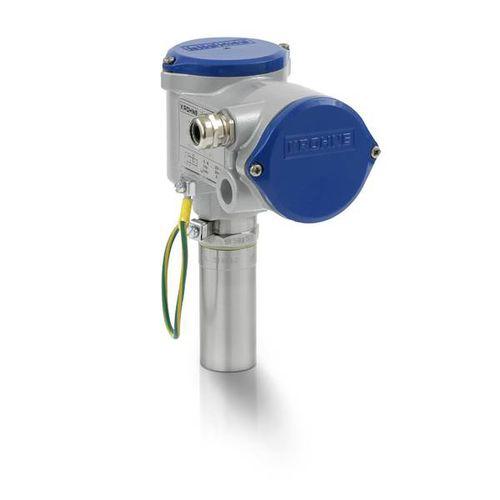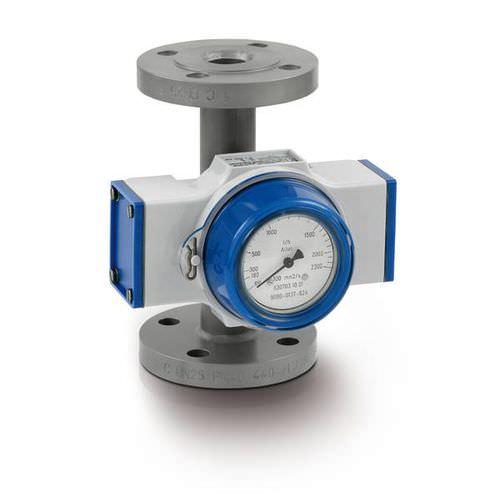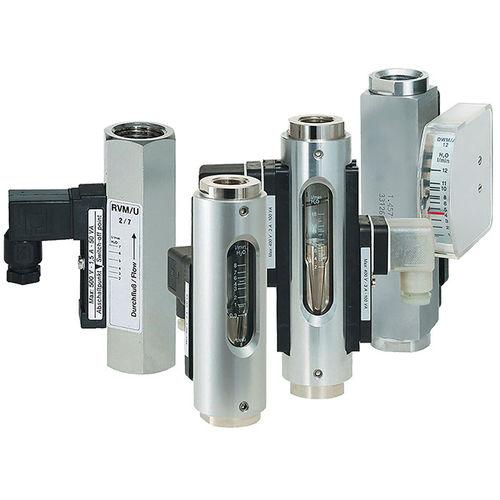


-
Technology:
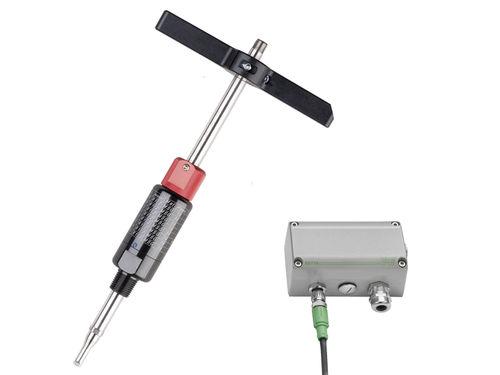
vortex
-
Fluid:
for gas
-
Mounting:
insertion
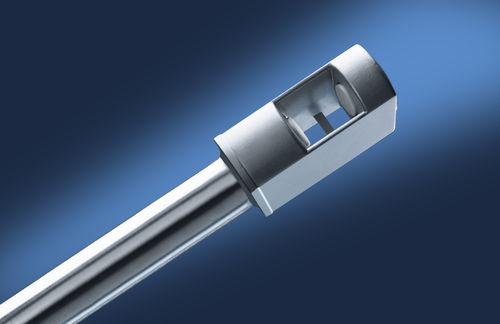
Derived from the Karman phenomenon of vortex shedding, the pinciple of measurement is based on vortices being shed when a flowing medium reaches a rod-shaped obstruction, whereby the vortex shedding frequency is a dimension for the flow velocity.
The flow vortices are ultrasonically scanned. In this way, compared to other scanning methods, flow velocities of as little as 0.5 m/s can be measured coupled with turndown ratios of 1 : 160. The vortices modulate the ultrasonic beam between an ultrasonic transmitter and receiver. The vortex frequency results from the demodulation.
A crucial advantage of the principle of measurement lies in the independence of density, pressure and temperature from the working medium.
Principle of measurement
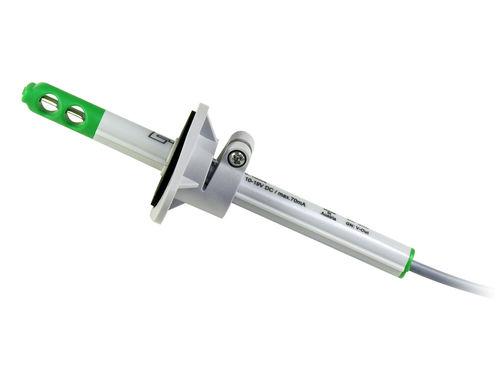
Vortex flow sensors VA have no moving parts, have outstanding fatigue strength even in rough conditions, excellent repeatability, long-term stability and are overload-proof. Measuring is practically inertia-free. The length of cable between sensor and evaluation unit can measure up to several hundred meters.
Solids are of no impairment as long as abrasion does not occur. In comparison to the vane wheel flow sensors, vortex flow sensors can be used for measuring in gases with considerably intensive solids content, without impairing the fatigue strength.
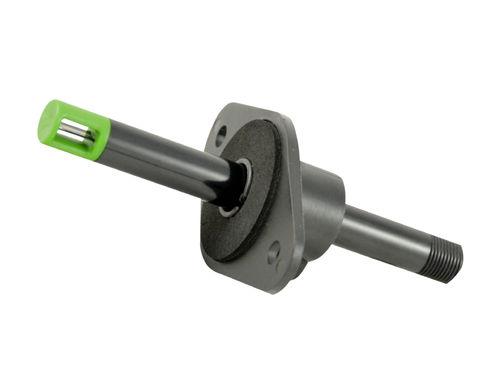
The pictured sensor with salt deposits was installed in a mine for several weeks. The slight deposits on the strut can easily be seen. In soiled condition drifts of max. +/- 0.3 m/s result for velocities of up to approx. 12 m/s.
vortex flow meter / for gas / insertion